
FIELD NOTES / DOUBLE CURVATURE
When Can Double Curved Aluminum Panels Share a Mold?
Group compatible panel shapes and distinguish physical part count from tooling count when comparing facade quotations.
Start with two counts
A schedule of 120 panels tells the fabricator how many parts to deliver. It does not establish the number of forming tools. Several panels may use a common tool even when their final trims, edge returns or bracket holes differ. Conversely, two panels with equal length and width can have different curvature and need different tooling. The paneling research by Eigensatz and colleagues examines mold reuse together with geometric quality targets.
Compare the actual face surfaces
Within a proposed family, align each nominal face to the candidate forming surface and review deviation over the usable region. Confirm whether the material and finish permit the proposed forming method, and whether tool access and clamping allow the parts to be formed and trimmed. A mirrored panel deserves a separate review because its orientation or local geometry may change the required setup. Have the fabricator confirm which differences can be handled after forming.
Agree on how the comparison will be judged
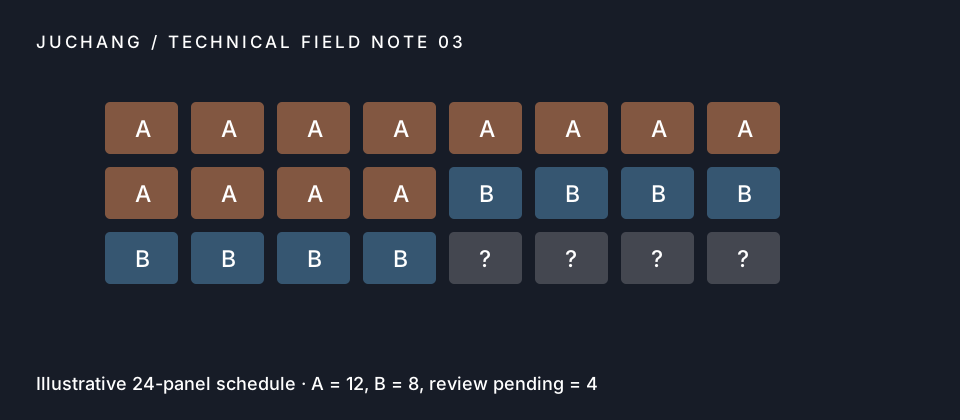
Consider a hypothetical elevation with 24 pieces. Twelve share a candidate forming surface, eight fit a second candidate and four are unresolved. The quote can show two candidate tool families and a provisional amount for the four outstanding parts. It should not assume every unresolved part needs its own mold or that all proposed families are approved. Record the maximum surface deviation and the seam continuity targets that govern approval.
Keep tooling and finishing visible on the quote
Ask for separate line items for tooling, forming, trimming, trial panels and finish. Record family IDs and individual panel IDs in the schedule. A revised panel may keep its tool family but require a new trim drawing. A change to the face geometry can require a new tool review. Compare quotes using the same drawing revision and require each bidder to identify unresolved parts and the assumptions behind its tooling count.
Technical references
- Zahner, Efficient Fabrication of Double Curved Surfaces ↗
- Eigensatz et al., Paneling Architectural Freeform Surfaces ↗
The sources describe general engineering considerations. Confirm product-specific values and project requirements with the responsible design team.